

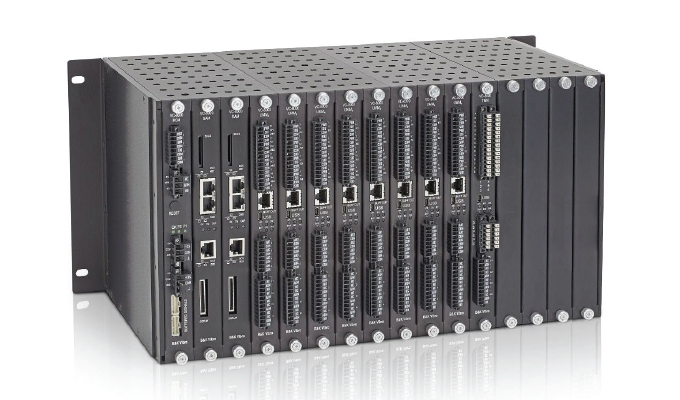
After costly fires caused by seal leaks of several important pumps, a major North American refinery decided to replace the legacy condition monitoring systems. The portable and online systems simply did not provide early or reliable enough warning of bearing faults to avoid the catastrophic failures.
The VC-8000/SetPoint system was selected for the task. Two case studies show how it was tailored to detect bearing faults at an early stage of development, continuously. It also provided vibration-temperature voting-logic protection, which ensured reliable protection without false trips for super-fast developing faults.
End result? No more fires! The system has proven itself in service.
HIGH-TECH REFINERY EFFICIENTLY DELIVERS CLEAN FUEL
The U.S.-based refinery in this case study processes almost 250,000 barrels of crude oil per day to produce transportation fuel and lubricating base oils. As transportation fuel is a major product at the refinery and only 40 percent of the crude oil can be distilled into these products, a fluidized catalyst cracker and hydrocracker are used at the refinery to maximize fuel production.
Production is further enhanced by the solvent de-asphalting unit (SDA), where heavy residues from the vacuum distiller can be re-processed to produce a de-asphalted oil that is later hydrogenated and used as feedstock in the FCC.
Moreover, by utilizing clean fuel technology and a unique base oil catalytic dewaxing process, the petroleum products delivered by the plant are ranked to highest quality standards.
In addition to clean fuel technology, an extensive ongoing modernization project has been under way that further improved the plant efficiency and reliability while also fulfilling strict environmental regulations for the future.
FAILURE PRONE PUMPS
The machine examined in this case study is the solvent booster pump, which pumps the extraction solvent under high pressure to the mixer/asphaltene separator in the SDA unit. There are three of these API 610 BB2 pumps, of which two must be operating at all times. If one of the pumps is down, then there is no spare.
The pumps have had a history of bearing and seal failures over the years. If the seals leak (e.g., a bearing failure causes the seals to open up), the volatile hydrocarbons escape and can ignite when they flash across the hot bearing or seal face surface, resulting in a fire. This has occurred several times in the past. Previous attempts to monitor the pumps failed, so eventually a VC-8000 machine protection unit was selected to monitor them.
LEGACY SYSTEMS MISS THE MARK
Previously, all monitoring for the pumps was done only with a hand-held vibration instrument on a weekly basis. This was considered sufficient since there was normally a 6-month lead-time from bearing fault detection to failure. The portable vibration device utilized a special measurement technique that could detect these particular faults at an early stage of development, but some bearing faults had only a six-hour lead-time, which is completely impractical for a portable instrument.
As some failures were occurring with less than six months lead-time at that time, it was decided to install a wireless system with thirty-minute monitoring interval and continue using the portable for diagnostics. The wireless system, which was only for condition monitoring, worked well for detecting typical bearing faults but was not effective for detecting fast developing bearing faults that were recently occurring at that time. The bearings in the pumps were failing without warning, which often lead to a fire.
In order to distinguish between a normal bearing fault (six months lead-time) and that with an accelerated development (six hours), it was decided to implement a temperature sensor, but there was still no machine protection with this monitoring configuration. Therefore, a protective monitoring solution was needed that could reliably detect and distinguish between the fast and slow developing bearing faults, and shut down the pump in time, as described in Case Study 1.
UNIQUE MONITORING STRATEGY
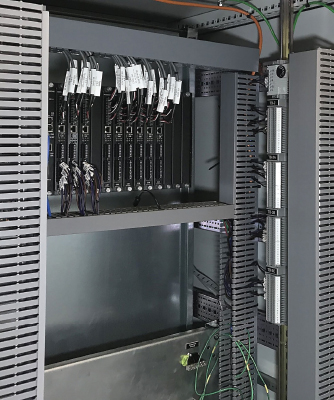
The VC-8000/SetPoint monitoring system for the solvent booster pumps currently employs the early bearing detection capability of the portable device, plus a voting logic shutdown strategy for both bearing vibration and temperature.
The sensor configuration consists of two accelerometers that are radially mounted on the driven and non-driven end bearing housings. On the non-driven end (thrust bearing), a displacement sensor is mounted through the bearing housing to axially monitor the shaft displacement.
This unusual configuration is based on the assumption that when the thrust bearing is at an advanced stage of failure or it is creeping along the shaft, there will be axial movement associated with this degradation, and this can be detected by the sensor. This is described in Case Study 2. In such a case a quick shutdown is necessary, not only because of the advanced state of failure for the bearing or shaft, but also since this same axial movement can provoke a seal leak that can be ignited into a catastrophic fire.
CASE STUDY 1: LOSS OF LUBRICATION TO THE PUMP
After several bearing failures of the solvent booster pumps, including some that resulted in a fire, it was determined that this condition was caused by loss of lubrication. As a typical bearing has a lead-time of six months from fault detection to failure, lubrication starvation accelerated this degradation to only six hours. The root cause, however, was unknown.
Subsequent investigation revealed that the cause of the loss of lubrication was due to the purge mist lubrication system. The bearings are lubricated by an oil ring. Oil mist is injected into the bearing housing at a pressure slightly greater than ambient to act as a purge, in order to avoid contaminates from entering the housing. The oil mist in this scenario is insufficient to lubricate the bearings on its own.
As a result of an installation error, an improper reclassifier fitting was mounted to the bearing housing during a previous service that allowed abnormally high over-pressured oil mist to push the oil level in the housing below the oil ring, and at the same time gave a false reading on the constant level lubrication system eye glass. As there was no contact between the oil ring and the oil, this resulted in loss of lubrication to the bearing.
After determining the root cause of the problem, the correct reclassifier was installed and the loss of lubrication problem ceased.
As a follow up, a VC-8000/SetPoint monitoring system was selected to replace the legacy condition monitoring system. To achieve this, it was modified to employ the early bearing fault detection technique used by the handheld so the fault could be monitored continuously. This monitoring technique, which was not available previously with an online system, was coupled with bearing temperature through relay voting logic. This enables the VC-8000/SetPoint monitoring system to quickly trip the pump before damage is incurred or a fire is started.
CASE STUDY 2: AXIAL DISPLACEMENT OF PUMP BEARING
During a previous major refurbishment of one of the solvent booster pumps, the damaged shaft was replaced by one that was newly machined instead of being repaired. Unfortunately, the replacement shaft was not completely up to spec; the outer diameter of the shaft bearing shoulder was undersized. After several months of operation, the newly installed VC-8000/SetPoint monitoring system issued an axial vibration alarm on the pump.
At first, it was believed that it was a false alarm but after the pump was disassembled and inspected, it was quickly observed that the shaft shoulder where the radial/axial thrust bearing sits up against was damaged.
This was later determined to be caused by the thrust loads in the pump pressing the bearing against the smaller shoulder and deforming it, which in return allowed the bearing to axially move along the shaft.
In this case the alarm was not the result of loss of lubrication or a defective bearing, but a deformed bearing shoulder on the shaft. If the pump shaft is allowed to move in the axial direction, even for a small displacement, this can unnecessarily stress the mechanical seals and lead to a leak. A leak on this pump can potentially ignite and result in a catastrophic fire.
During service, a shaft with the correct dimensions was installed and the problem of axial movement or “creep” of the bearing disappeared.
BENEFITS OF RELIABLE, EARLY FAULT DETECTION WITH CONTINUOUS MONITORING
The solvent booster pumps presented two special monitoring challenges that could not be addressed by the legacy condition monitoring systems. Early bearing fault detection is very important for these and many other refinery pumps, since the radial or axial displacement of a failing bearing can provoke a premature seal leak, which cannot be tolerated because of the risk of fire.
In the first case study, the VC-8000/SetPoint monitoring system was selected as a protective solution, partly because of its ability to be modified quickly to the special application requirements by making only firmware changes.
In the second case study the VC-8000/SetPoint monitoring system proved successful in avoiding a seal leak caused by unexpected axial movement of the shaft. This was done using a displacement sensor that was not present on the previous system. The VC-8000/SetPoint monitoring system is designed to detect all kinds of faults, including installation and service faults, not just typical bearing wear.
The VC-8000/SetPoint monitoring system paid itself off within the first year of installation. Satisfied with the results, the refinery is currently assessing monitoring other pumps with the VC-8000/SetPoint monitoring system in an effort to increase asset reliability, reduce maintenance and pump lifecycle costs, improve machine uptime and mitigate the risk of costly fires.
Brüel & Kjær Vibro (B&K Vibro) is the leading worldwide independent supplier of condition monitoring solutions for rotating machinery. The comprehensive product range comprises vibration sensors (acceleration, velocity and displacement), vibration monitors, handhelds and rack-based plant-wide integrated monitoring solutions. These products plus a suite of comprehensive services fulfil the most demanding applications for safety, condition and performance monitoring of rotating machinery. Based on more than eighty years of experience and a world-wide sales and support network, B&K Vibro’s monitoring solutions have successfully reduced downtime and maintenance costs and increased machine reliability for our customers worldwide. For more information, visit www.bkvibro.com.