

Read part 1 here.
As we mentioned in the first part of this series, choosing the right safety relief valve (SRV) is crucial for system safety, compliance, and efficiency. Below, let’s walk through the components that you should be familiar with when assessing these indispensable valves, from nozzle design to seat types and advanced seat features to balanced bellows.
NOZZLE DESIGN
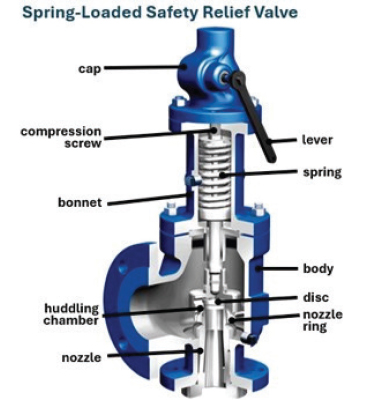
Spring-loaded SRVs are available in two distinct valve designs: the semi-nozzle and the full nozzle.
Semi-Nozzle Valves
A semi-nozzle valve, like the ARI-SAFE series, features a partial nozzle design where the inlet margin of the valve seat is integrated into the main valve body. This design reduces overall material costs and is often suitable for applications involving moderate pressure and non-corrosive media. Semi-nozzles are easier to manufacture and maintain due to their simpler design. Their cost-effectiveness makes them an ideal choice in general-purpose applications, particularly where operating conditions do not impose extreme demands on the valve’s performance or resistance to wear and corrosion.
Full-Nozzle Valves
On the other hand, a full-nozzle valve features a fully separate and replaceable nozzle that serves as the seating surface. This design provides enhanced durability and resistance to wear, making it particularly well-suited for high-pressure applications or systems handling corrosive, abrasive, or high-temperature media. Full-nozzle valves offer greater longevity and flexibility in demanding environments, as the nozzle can be replaced independently without compromising the valve body.
The choice between the two depends on the specific application requirements. A semi-nozzle valve is appropriate for cost-sensitive settings with moderate pressures and non-corrosive media.
Conversely, a full-nozzle valve should be chosen for critical applications requiring increased durability, high resistance to extreme conditions, or frequent system cycling.
In addition to selecting between semi-nozzle and full-nozzle SRVs, several decisions must be made regarding key details. The choice of seat type, whether metallic or elastomer, is particularly important. It is essential to evaluate the need for balanced bellows and determine whether an open or closed bonnet design is appropriate. A variety of cap types are also available. Choosing the right materials for the body and trim is also essential to ensure they are compatible with the process media and operating conditions.
SEAT TYPES
The seat of a spring-loaded safety release valve plays a crucial role in ensuring reliable sealing and optimal performance. There are two primary options available: metallic seats and soft seats, each designed for specific applications.
Metallic Seat
Metallic seats are the most commonly used seating design, featuring a metal-to-metal seal between the disc and nozzle. They are favored for their durability and exceptional performance in high-temperature and high-pressure environments. Resistant to wear and chemical damage, metallic seats are well-suited for demanding industries such as petrochemicals and oil and gas, where robustness takes precedence over achieving a perfect seal. However, they may allow minimal leakage in low-pressure systems.
Soft Seat
Soft seats are utilized in applications where tight sealing, process purity, or emission control is critical. Constructed from elastomers or polymers, they provide superior sealing and are the preferred choice for low- to moderate-pressure systems, particularly when handling expensive or hazardous fluids. While highly effective in these specific applications, soft seats have limitations, including reduced resistance to high temperatures and chemical exposure, making them unsuitable for extreme operating conditions.
ADVANCED SEAT FEATURES
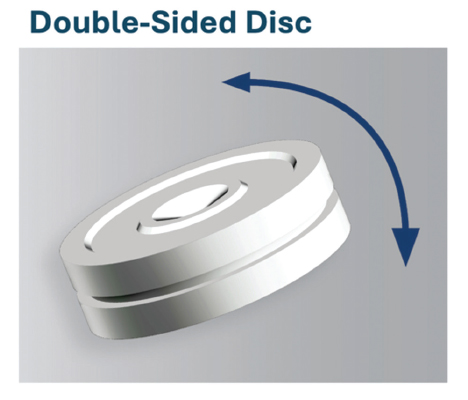
To extend the service life of metallic seats, ARI incorporates a double-sided, reversible metal disc as a standard feature in its Reyco safety relief valves. This unique design allows the disc to be flipped and reused, effectively doubling its lifespan and providing a readily available spare part.
Moreover, the Reyco SRVs employ a radial bearing design to enhance seat tightness and sealing capabilities. This design helps the valve hold pressure better and have better repeatability in opening and closing. The spherical structure of the radial bearing distributes force evenly across the valve seat, addressing the limitations of traditional designs where force is only applied vertically. Furthermore, the valve disc includes 140° notched bearing points to ensure precise concentricity.
BALANCED BELLOWS
Balanced bellows are essential components in semi-nozzle and full-nozzle safety relief valves (SRVs), addressing two critical challenges: managing backpressure and handling demanding media.
Backpressure Management
Balanced bellows are highly effective in mitigating backpressure by isolating it from acting on the upper side of the disc within the bellows area. This design increases the spring force on the disc, ensuring higher system pressure is required to initiate a release. When built-up backpressure exceeds 10 percent of the valve’s set pressure (or cold differential set pressure), it can compromise capacity and destabilize valve performance. In such scenarios, using a bellows becomes necessary to maintain proper functionality under two specific backpressure conditions:
- Excessive or Variable Backpressure: When backpressure at the valve outlet is excessive or fluctuates by more than ±10 percent of the nominal pressure prior to a relief event, a bellows ensures stable and reliable operation.
- Disproportionate Built-Up Backpressure: During a relief event, built-up backpressure can result from friction, turbulence, or pressure drops in the discharge piping. A bellows helps counter these effects, preserving valve performance.
Handling Challenging Media
In addition to regulating backpressure, balanced bellows safeguard the valve’s internal components, such as the guide and spring, from exposure to process fluids. This protection is especially critical when dealing with corrosive or obstructive media.
- Corrosive Media: In applications involving corrosive fluids, bellows serve as an essential barrier, isolating the bonnet cavity from the process stream to protect sensitive components.
- Obstructive Media: In applications with slurries, highly viscous substances, or media prone to clogging critical clearances between the guide and disc holder, bellows act as a protective shield, preventing blockages and ensuring smooth, uninterrupted operation.
MATERIALS
When selecting a safety relief valve, it’s essential to prioritize state-of-the-art materials, backed by rigorous R&D and quality-controlled manufacturing, to ensure performance and reliability in critical applications.
Body
Not all valve manufacturers have modernized their R&D and production processes for WCC carbon steel to comply with the updated ASME standards for ductility. This ensures that valve bodies, bonnets, and caps can pass impact tests and operate reliably at temperatures as low as -20 degrees Fahrenheit (-6.7 degrees Celsius). In contrast, some manufacturers rely on expensive alloy upgrades to achieve low-temperature performance, adding unnecessary costs.
Trim
All trim components should feature high-quality materials suitable for diverse applications in the standard trim package. For example, ARI-Armaturen bellows are equipped with Inconel® trim as a standard feature, eliminating the need for special orders to meet NACE compliance. This helps streamline inventory management by reducing the number of unique spare parts that need to be stocked and maintained. Valves with bellows trim made from Inconel 625 LCF offer superior corrosion resistance and an extended service life, fully compliant with NACE MR0175 or MR0103 standards.
SELECTING THE RIGHT SUPPLIER
The vast array of safety relief valve types, trim components, and materials creates results in tens of thousands of possible combinations. That’s why it’s essential to partner with a valve supplier that prioritizes simplicity without compromising performance.
An ideal supplier offers streamlined valve designs crafted from versatile, high-performance materials, reducing the number of options and components. This not only simplifies the selection process but also minimizes the need to stock excessive spare parts. Standardized valve models and fewer optional components further ease the burden of team training and system maintenance.
Moreover, a dependable supplier should maintain a vast U.S.-based inventory and robust manufacturing capacity, ensuring quick fulfillment of initial orders, replacements, and spare parts.
ARI can look back on a tradition of more than sixty years as a partner for control, isolation, safety and steam trapping of liquid and gaseous media. ARI-Armaturen USA, the North American branch of ARI, was opened in Texas in 2004 to supply customers in the United States, Canada, and Mexico. As an efficient partner offering a wide range of products with custom product solutions, a production facility fitted with the most up to date technology and a local comprehensive customer service, success came quickly. For more information, visit www.ari-armaturen.us.