

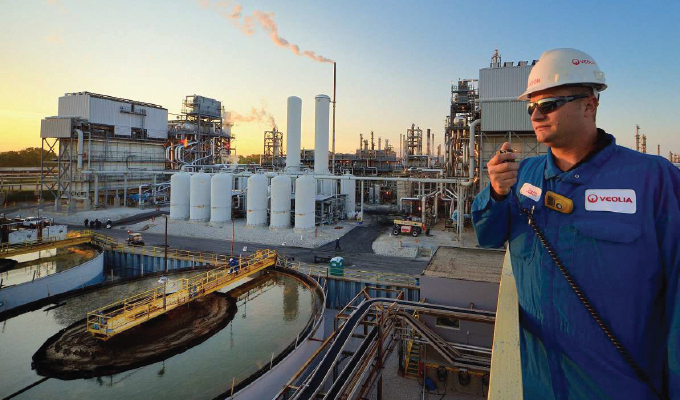
Toledo Refining Company (TRC) of Oregon, Ohio, has partnered with Veolia North America in a twenty-year term agreement in which Veolia operates and maintains the refinery’s on-site wastewater treatment facility. The treatment plant recovers 50 percent of the plant’s wastewater for reuse in the refining process.
Located near Toledo, Ohio, TRC’s Toledo Refinery processes light, sweet North American crudes. With a capacity of 170,000 barrels per day, the refinery primarily produces fuels, including gasoline, ultra-low sulfur diesel, and jet fuel, plus a variety of high-value petrochemicals. The refinery relies on Veolia to maintain safe, reliable operations at the treatment plant to ensure the refinery can continue running properly. TRC is a wholly owned subsidiary of PBF Energy Company of Parsippany, New Jersey. PBF is one of the leading independent petroleum refiners and suppliers of petroleum-based products in the United States.
THE CHALLENGE
All refining processes produce solids and oily wastewater that must be treated for discharge or reuse. In TRC’s case, their wastewater treatment plant discharges to the local, publicly owned treatment works (POTW). The refinery needed a solution to upgrade and optimize their wastewater treatment systems within their budget and timeline restrictions, and sought a partner in Veolia North America.
“Toledo Refining makes the fuels, and we make their water clean again so they can reuse it in their processes. Our treatment plant removes solids and other residues from the water, and Veolia’s team manages day-to-day maintenance so that the refinery can concentrate on their core business.”– Bryan Zimmerman, Veolia North America project manager
THE SOLUTION
As part of Veolia’s process upgrade and optimization solution, Veolia met with the client at its manufacturing plant to review and assess the water reclamation plant operations. They identified equipment that needed to be added for optimal process performance, and implemented a project plan that met the client’s goals and budget. The resulting proposal called for Veolia to finance, design, build, own, operate, maintain and manage services and upgrades to the refinery’s water treatment process under a long-term, twenty-year contract.
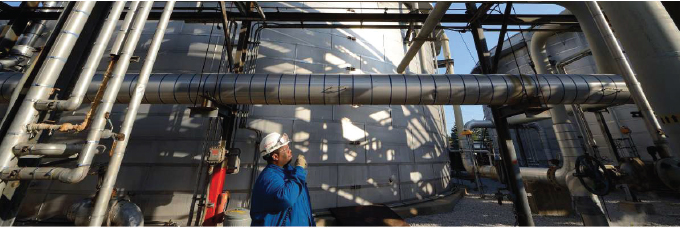
Fifteen Veolia employees operate and maintain the wastewater treatment plant around the clock. The staff includes a project manager, operations manager, eight operators, a maintenance manager, three maintenance mechanics and an administrative assistant.
“Toledo Refining makes the fuels, and we make their water clean again so they can reuse it in their processes,” says Bryan Zimmerman, the Veolia project manager who is based at the client’s site. “Our plant removes solids and other residues from the water, and our mechanical crew handles day-to-day maintenance so that the refinery can concentrate on their core business.”
Veolia treats the wastewater using a variety of advanced technologies. First, the wastewater is collected and screened to remove solids, including debris. Oil is then removed in an API separator and a dissolved nitrogen flotation system. Next, the water is sent to secondary treatment that consists of aeration to remove residual organics and inorganics, and then to a two-train clarification system. Treated effluent from the clarifiers is split into two “streams.” The quality of the effluent is high enough to split a portion for discharge to the municipal treatment plant and the rest to tertiary treatment, or “polishing,” using five sand filters. The polished water is then recycled as “make-up water” for the refinery’s cooling towers.
“The quality of the polished water is very important,” explains Zimmerman, “because the refinery’s cooling towers need clean water to run properly.”
A key advantage to having Veolia operate the refinery’s wastewater treatment system is experience.
“With many years of experience operating and maintaining these types of plants, we are able to adapt to changing situations,” says Zimmerman. “We can easily adapt and adjust our process chemistry to meet the refinery’s needs.”
THE RESULTS
Throughout the partnership, the refinery has saved a significant amount of money by reducing purchases of city water and lowering treatment costs by directing less wastewater to the city’s treatment plant. Just as importantly, this sustainable solution reduces demand on local water supplies. In addition, the refinery has benefited from reduced risks, significant cost savings, and being able to focus resources on its core business of oil refining, rather than treating wastewater.
The refinery continues to work with Veolia on ways to increase the percentage of treated water available for reuse. According to Aaron Coulter, TRC’s area manager, “The refinery is always looking at ways to increase recycling and reuse. Although the treated water currently meets our specifications, Veolia would have to treat the water to a higher level for us to expand its use, which would require further investment.”
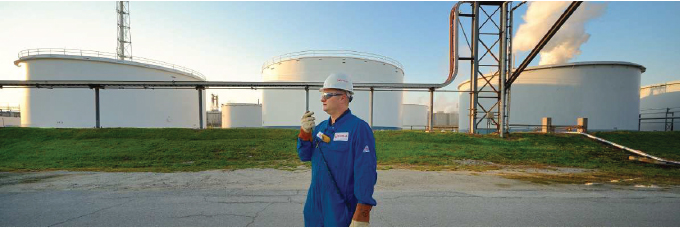
“Veolia employees have an excellent safety record at our plant,” says Zimmerman. “Employees are active on the safety committee, and we host monthly safety meetings that everyone attends. Our people are committed to working safely and their dedication shows,” explains Zimmerman. “In more than fourteen years at the site, Veolia employees have had only one recordable incident—a sprained ankle.”
The success of the wastewater treatment plant’s operation is often attributed to constant communication between Veolia and refinery staff, notes Zimmerman: “Although refinery and Veolia personnel hold regular meetings, most communication happens on a real-time basis. This allows us to do a better job controlling processing costs and maintaining water quality on our end.”
Coulter, the refinery’s area operations manager, agrees that open communication between the two companies’ staffs is important. “We give the wastewater plant notice if there are any changes in the refinery, and Veolia wastewater plant personnel do the same for us. The success of our relationship is a combination of people, experience and communication.”
Veolia aims to be the benchmark company for ecological transformation. With 215,000 employees worldwide, Veolia designs and provides game-changing solutions that are both useful and practical for water, waste and energy management. Through its three complementary business activities, Veolia helps to develop access to resources, preserve available resources, and replenish them. For more information, visit www.veolia.com.