

Read part 1 here.
As we pointed out in part 1 of this series, flow measurement is one of the most important measuring principles in process control—particularly in applications where thermal energy is transferred via liquid cooling circuits, such as in data centers. Below, let’s examine the fundamentals of flow measurement in cooling applications, especially process conditions that define measurement accuracy and ensuring the cleanliness of the piping system.
FUNDAMENTALS OF FLOW MEASUREMENT IN COOLING APPLICATIONS
Process Conditions Define Measurement Accuracy
Flow measurement is one of the most important measuring principles in process control–particularly in applications where thermal energy is transferred via liquid cooling circuits, such as in data centers. Accurate and reliable flow data are essential to ensure stable operation, optimize energy use, and detect anomalies in real time.
The accuracy and reliability of flow measurement depend not only on the selected flowmeter technology and specific device type, but also heavily on the prevailing process conditions and on the correct mechanical installation. Factors such as flow profile, pipe orientation, temperature and pressure variations, as well as the presence of air bubbles or impurities in the coolant, can significantly influence measurement performance.
Flowmeter Installation
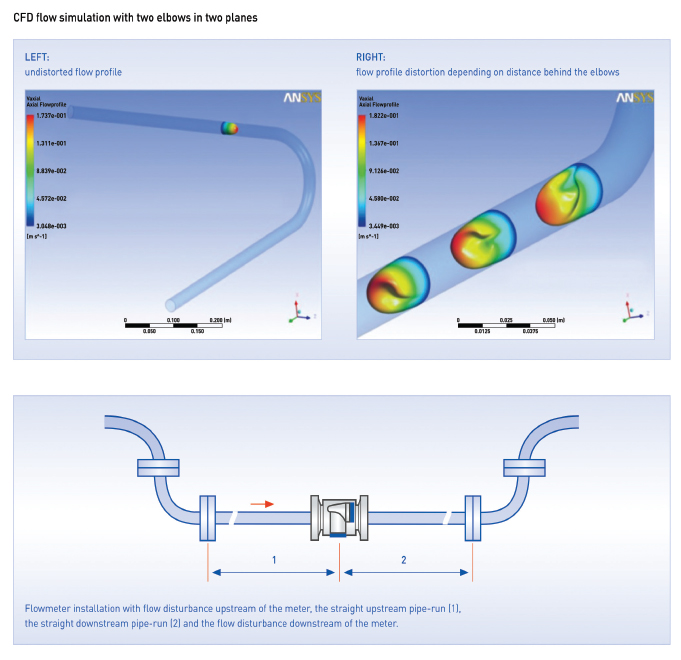
The accuracy of many flowmeters depends on the existing flow profile in the pipe whereas some other flowmeter versions can cope with flow profile disturbances without big additional error margins. The influence on the flow profile at the measuring point is depending on the disturbance like for example a tee, an elbow or a valve and the straight pipe run upstream of the flowmeter. In the CFD simulation the fully developed undistorted flow profile before the two elbows can be seen on the left picture. The profile distortion in different distances behind the elbow are shown in the right picture.
Cleanliness of the Pipes
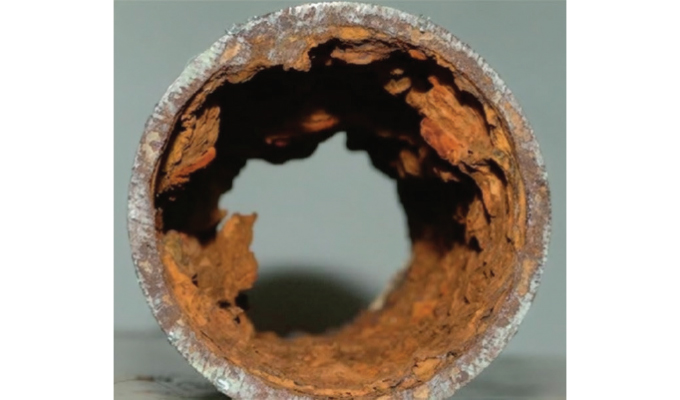
Clean internal surfaces of the pipes, the cooling system and other equipment not only guarantees a good heat exchange it also is a requirement for stable measurement results with consistently high accuracies. Therefore, a suitable construction material of the pipes and the filling of the cooling system with conditioned heat transfer fluids is recommended. In case of scaling whether conductive or non-conductive the measurement performance of the flowmeters can be negatively influenced. Silica dissolved in water can lead to a non-conductive scaling on the surfaces, the presence of corrosion products in ferritic pipes can cause magnetite scaling. In both cases electromagnetic flowmeters are mostly affected by such types of scaling, even if the layers are very thin.
OVERVIEW OF FLOW MEASUREMENT TECHNOLOGIES AND PRINCIPLES
Flowmeters measure the flow of coolant and, in combination with the temperature difference, determine the amount of thermal energy transported from point A to point B. They are essential to ensure sufficient cooling capacity and to monitor energy flows within the system.
As heat transfer fluids and operating conditions vary depending on the specific design and size of the data center cooling system, selecting an appropriate flow measurement technology is critical. Factors such as fluid properties (e.g. water, glycol mixtures), flow velocity, pipe diameter, installation constraints, and maintenance requirements must be taken into account.
This section provides an overview of the most common flow measurement principles used in data center applications, including their respective advantages, limitations, and suitability for different types of cooling circuits. The aim is to support planners and engineers in selecting the most appropriate technology based on technical and economic criteria.
Electromagnetic Flowmeters
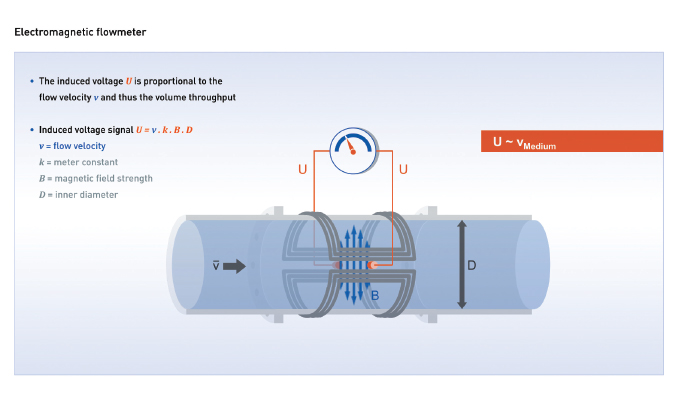
Electromagnetic flowmeters are widely used across different industries. They are used to measure the flow of conductive liquids by applying Faraday’s law of electromagnetic induction. They consist of a non-conductive pipe with magnetic coils and electrodes. As the fluid flows through the magnetic field, it generates a voltage proportional to its velocity, which is used to calculate flow.
There are different designs with full bore and reduced bore. Its accuracy, performance and stability depend on the installation conditions and the cleanliness of the meter tube and the electrodes over time. In general, electromagnetic flowmeters offer good accuracies even at distorted flow profiles since the electromagnetic field covers a big cross-section of the flow profile.
Drift can occur in all components of the flowmeter used to generate the measuring effect, in the transmitter with the measuring amplifier, as well as in the sensor with the coils and the electrodes through to correct earthing. Therefore, a sophisticated design that compensates for temperature and long-term effects as well as process-related changes in the best possible way is essential.
Scaling causes basically two effects, it reduces the internal pipe diameter and thus leads to a smaller flow reading and it may cover the electrodes. In case of an isolating non-conductive scaling, it will reduce the voltage picked up by the electrodes, in case of a conductive scaling it may shortcut the two electrodes and will reduce the measuring effect as well. Especially magnetite formation has a big impact on the meters drift. Magnetite can form at elevated temperatures and with the presence of corrosion products. The usage of non-ferritic pipes and the conditioning of the heat transfer fluid can avoid magnetite formation.
Ultrasonic Flowmeters
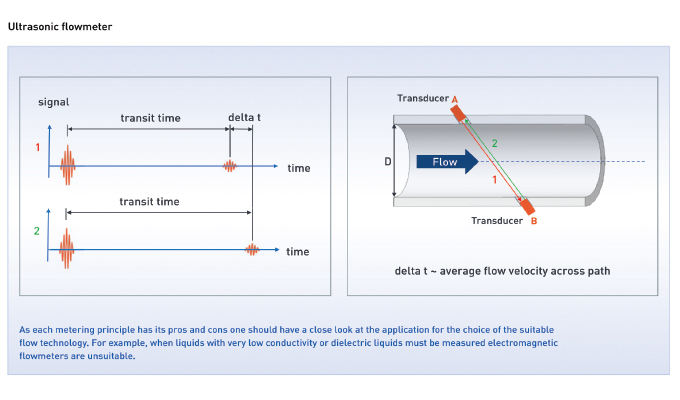
Ultrasonic transit time flowmeters are using acoustic signals for the measurement of flow. Ultrasonic transducers are utilized for the generation and reception of acoustic signals. Arranged in pairs, one upstream, the other downstream, signals are sent and received against and with the flow. The transit time differences are proportional to the flow velocity.
The flowmeters can be designed as inline or clamp-on meters. Inline meters allow a chordal arrangement of multiple acoustic paths. By this sufficient flow information across the flow profile can be gathered. Together with a calibration of the meter tube achieving very high accuracies. Clamp-on meters can be installed retrospectively without cutting the pipe with limitations in the accuracy.
As the measurement principle is based on time measurement, there is virtually no drift in the meter. As the measurement is a differential measurement temperature changes affect both signal directions against the flow and with the flow equally and thus are eliminated. Ultrasonic flowmeters mostly require slightly more straight pipe length compared to EMFs in case full accuracy is required. There are meter for liquids, gases and steam available. No minimal conductivity is required.
KEY CONSIDERATIONS FOR CHOOSING THE OPTIMAL FLOWMETER
As each metering principle has its specific strengths and limitations, selecting the appropriate flow measurement technology requires a thorough understanding of the application requirements. Parameters such as the type of coolant, its conductivity, flow rate range, pipe dimensions, system pressure, and installation environment all play a critical role in determining which technology is most suitable.
Stefan Kranz is global industry division manager power generation for Krohne and can be reached at s.kranz@krohne.com. Krohne is a worldwide technological leader in the development, manufacture and distribution of accurate, reliable and cost-effective measuring instruments for the process industries. Krohne focuses on forming partnerships with its customers to provide them with the most reliable and innovative solutions available in the marketplace. For more information, visit www.krohne.com.