

Pump manufacturers play an important role in helping customers meet evolving municipal vertical turbine pump regulations and standards while simultaneously optimizing performance. Working with industry organizations like the Hydraulic Institute (HI), the global authority on pumps and pump systems, helps maintain compliance with key pump standards and puts companies in a good position to keep up with industry trends.
WHAT ARE THE DIFFERENT TYPES OF PUMP STANDARDS AND WHY DO THEY MATTER?
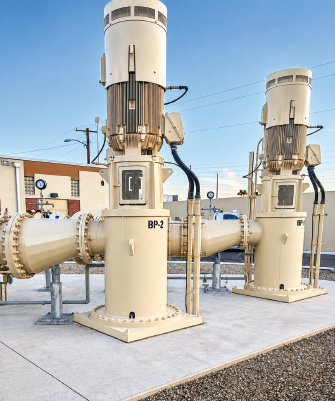
The American Water Works Association (AWWA) has developed more than 150 consensus standards for equipment used in critical municipal water applications. These include detailed standards covering minimum requirements for vertical turbine pumps, for example, American National Standards Institute (ANSI)/AWWA E102 for submersible types and E103 for vertical line shaft types.
The American National Standards Institute (ANSI) has certified the Hydraulic Institute as an approved standards development organization. HI publishes complementary standards addressing pump design, performance, testing, installation, and maintenance. This includes more than 30 national standards covering pump and system nomenclature, definitions, design, application, installation, operation, maintenance and testing.
HI standards cover the whole range of positive displacement and rotary type pumps. Municipal projects often mandate compliance with these respected standards, providing engineers and stakeholders documented assurance of safety, quality, and reliability. National Pump Company (NPC) is currently serving on 19 HI training and certification program committees and contributing to the creation and revision of industry standards, guidebooks, and tools.
In addition to ANSI and HI standards, pumps used for potable water frequently require NSF/ANSI 61 certification to confirm that materials used are safe for drinking water systems. ISO 9001 certification is commonly requested for manufacturers to guarantee rigorous quality assurance in the manufacturing processes.
What’s more, municipalities are increasingly demanding pumps that meet operational requirements while also delivering measurable energy savings. Compliance with U.S. Department of Energy (DOE) efficiency standards (or equivalent energy performance mandates in other countries) are becoming standard in bid specifications. This serves to reduce operational costs while aligning with government policies for sustainable water management.
As municipalities strive to optimize maintenance, reduce downtime, and maximize pump runtime, Internet of Things (IoT)-enabled performance tracking, automated monitoring, and even artificial intelligence (AI)-based diagnostics are gaining traction. Many stakeholders have cited these smart features as critical to purchasing decisions, reflecting a shift toward more data-driven and proactive water infrastructure management.
EVOLVING REGULATIONS AND STANDARDS ARE INFLUENCING PUMP DESIGN AND MATERIAL SELECTION
In recent years the Hydraulic Institute has been pushing for greater consistency, trying to move the industry from a system in which individual companies have maintained an often confusing inconsistency in various aspects, to one with a standardization between manufacturers.
Another key trend is a push for regulations that ensure materials used in pumps do not have a negative effect on human health. To this end, HI standards committees are working on finding alternative pump materials, testing them to see how they perform in the field, and aligning them with existing standards and regulations.
One significant example is the use of per- and polyfluoroalkyl substances (PFAS), a large group of synthetic chemicals prized for their water-resistant capabilities and used since the 1950s.
Until recently, PFAS materials’ excellent sealing properties and surface profile for efficiency and performance made it the go-to material for many pumps. Now that the industry has come to understand its harmful health effects, there has been a move toward developing standards governing the applications in which the material is – or is not – acceptable. For example, PFAS is increasingly prohibited for pumps designed for use in drinking water treatment plants, but might be acceptable in an industrial plant for processing steel (or in other cases in which the pumped fluid is not potable). It might also be considered if it is the only material available for a specific application. Standards committees and manufacturers are working with material scientists to define acceptable limits, develop alternative materials, and establish test methods that verify those materials do not adversely affect human health.
PFAS-related regulations are evolving and vary by state; most are targeting specific uses. One example is California, which is currently considering regulating PFAS use in camping and cooking equipment and firefighting foam, but not considering its use in pumps, whose wide range of uses make it more difficult to carve out meaningful standards.
As an industry, pump manufacturers and parts producers are currently working with material scientists to find materials that can replace PFAS while working as well, and without incurring large cost increases.
BENEFITS OF COMPLIANCE-DRIVEN DESIGN CHANGES
One of the most often overlooked considerations is the benefits of compliance-driven design changes to reliability, efficiency, or total cost of ownership (TCO). Any change in an industry standard nearly always benefits the end user.
Sometimes, those in a particular industry do not agree initially, because they have become used to doing things a certain way. Take the example of the agriculture industry, in which lower efficiency electric motor standards were the norm. Since the DOE mandated a change to newer premium efficient motors, the industry’s TCO has been much reduced. Over time, industry-wide costs come down as the supply chain adapts, and manufacturers can supply higher efficiency equipment without detriment to the end user.
A LOOK AHEAD
In next month’s conclusion to this article, we’ll see how work on HI committees helps anticipate and adapt to regulatory and performance trends and how experts work to ensure that certification and testing processes meet standards and certifications. As you’ll see, work on standards promotes the continued success of pumps and their systems not just for operators in the field today but for the next generation as well.
Kenric Freiwald is a product development engineer at National Pump Company, a Gorman-Rupp Company brand, specializing in vertical turbine line shaft and submersible pump systems for agricultural, municipal, industrial, and oil and gas applications. He has progressed from Application Engineer through project engineering roles into product development, working across system selection, detailed mechanical design, and standards compliance (HI, API, AWWA, NSF). His expertise includes pump hydraulics, vibration analysis, mechanical design, and manufacturability, with experience supporting engineering workflow and configurator improvements. He holds a B.S. in Mechanical Engineering from Northern Arizona University, where he served as Drivetrain Team Lead for the SAE Baja competition team, and maintains a certification as a Vibration Institute Category I Analyst. For more information, visit www.nationalpumpcompany.com.