

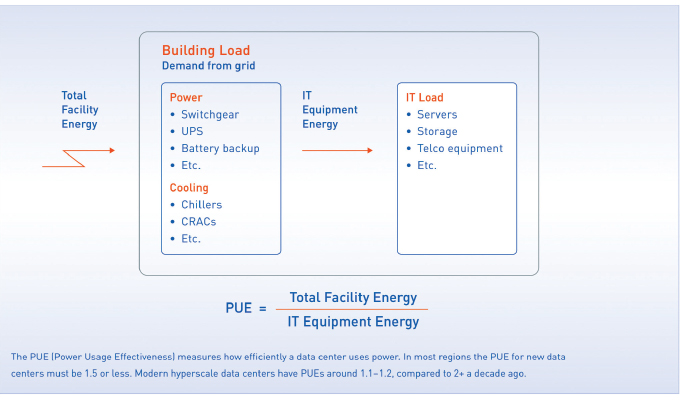
In today’s digital age, data centers are the backbone of our information society. They enable the operation of cloud services, the storage of large amounts of data and the performance of complex calculations. As demand for digital services grows, so does the energy requirements of these facilities. Data centers are among the largest energy consumers worldwide, and their efficiency is crucial for reducing their environmental footprint and lowering operating costs.
A key aspect of energy efficiency in data centers is cooling. The enormous amount of heat generated by servers and other IT infrastructure must be effectively dissipated to ensure smooth operation and prevent failures. This is where innovative technologies come into play, optimizing cooling cycles and increasing energy efficiency.
The availability and safety of data centers are essential for their operation thus the supply of electricity and cooling is backed up by uninterruptible power supply (UPS) and redundant systems.
The availability and safety of data centers are essential for their operation thus the supply of electricity and cooling is backed up by uninterruptible power supply (UPS) and redundant systems.
Data centers require a lot of energy for the supply of electricity and cooling. Despite their explosive growth, the industry has made big strides in limiting environmental impact. The key is in combining efficiency, innovation, and sustainability practices. Also, the reuse of heat for district heating or industrial use significantly reduces carbon emissions. At many locations the energy use and the efficiency must be also monitored or reported via an energy management system such as ISO 50001 or similar. In other regions ASHREA thermal guidelines for data processing environments apply.
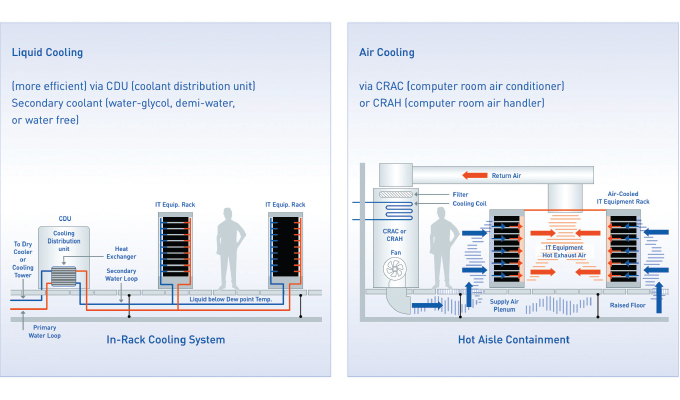
The heat must be dissipated from the microprocessors and equipment to keep them cool and in the desired temperature range for their safe and efficient operation. While initially primary cooling was done by air and secondarily the air was cooled by computer room air conditioners CRAC, modern highly efficient systems work with liquid coolant in direct contact to the equipment allowing higher rates of heat transmission.
COOLING STRATEGIES AND SYSTEM ARCHITECTURES IN DATA CENTERS
For the reliable operation of servers and related hardware, sufficient and consistent cooling is essential – alongside other infrastructure measures such as uninterruptible power supply and fire protection. Cooling is typically achieved through systems such as CRAC (Computer Room Air Conditioner) or CDU (Coolant Distribution Unit), which help remove the heat generated by high-performance IT equipment.
A continuous and stable coolant flow must be ensured to effectively transfer heat away from the heat sources and maintain the required ambient conditions in server rooms. As data center densities increase and rack power consumption rises, the importance of efficient thermal management becomes even more critical.
Modern data center cooling strategies range from traditional air-based systems to increasingly popular liquid cooling technologies, such as directtochip or immersion cooling. Each approach places different demands on the cooling infrastructure, including flow measurement, temperature control, and energy monitoring.
SELECTION AND CHARACTERISTICS OF HEAT TRANSFER MEDIA
Heat transfer fluids for data centers can differ significantly, and selecting the appropriate fluid is crucial for the efficient operation and longevity of the cooling system. These fluids can range from water-based solutions to specialized coolants, each with unique thermal properties, viscosity, and chemical composition. The choice of fluid has a major influence on scaling and corrosion within the system, which can impact both performance and maintenance requirements.
The compatibility of flowmeter technology with the chosen heat transfer fluid is essential. Flowmeters must be able to accurately measure the flow rate and detect any anomalies in the system, regardless of the fluid’s properties.
Conductivity
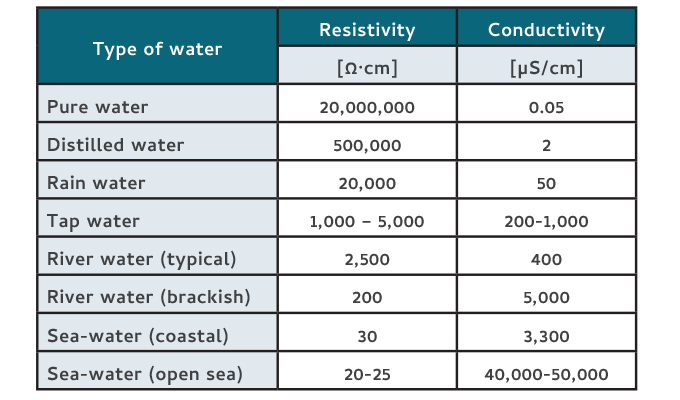
Electromagnetic flowmeters need a minimum conductivity. Based on type, electrodes, grounding a minimum conductivity of 1 to 25 µS/cm is necessary for a good and reliable operation. Demi water, oil or other dielectric heat transfer fluids do not have sufficient conductivity to be measured with electromagnetic flowmeters.
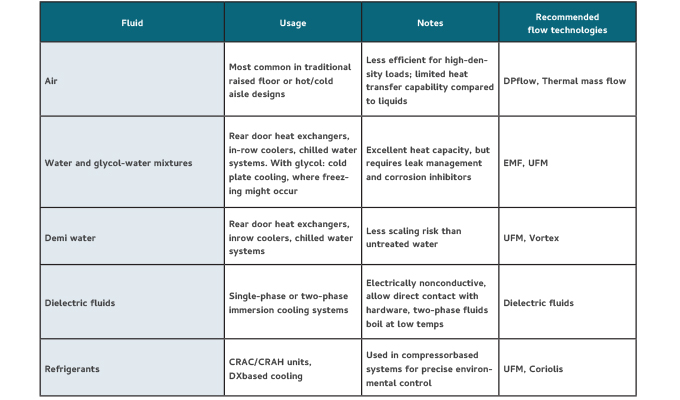
Key Fluid Characteristics and Flowmeter Requirements
In table 2, we provide a comprehensive table that outlines various heat transfer fluids used in data center cooling systems, detailing their distinct properties and the specific requirements for flowmeter technology. This information is crucial for ensuring optimal performance and longevity of cooling circuits, as well as for minimizing issues related to scaling and corrosion. By understanding the characteristics of each fluid and the corresponding flowmeter compatibility, data center operators can make informed decisions that enhance energy efficiency and reduce maintenance costs.
A LOOK AHEAD
Flow measurement is one of the most important measuring principles in process control—particularly in applications where thermal energy is transferred via liquid cooling circuits, such as in data centers. Next month, we’ll conclude this series by examining the fundamentals of flow measurement in cooling applications, especially process conditions that define measurement accuracy and ensuring the cleanliness of the piping system.
Stefan Kranz is global industry division manager power generation for Krohne and can be reached at s.kranz@krohne.com. Krohne is a worldwide technological leader in the development, manufacture and distribution of accurate, reliable and cost-effective measuring instruments for the process industries. Krohne focuses on forming partnerships with its customers to provide them with the most reliable and innovative solutions available in the marketplace. For more information, visit www.krohne.com.