

Miss Part 1? Read it here.
Last month, in the first part of this series, we introduced some of the intricacies of Coriolis flow meter technology. Below, we continue by offering a comprehensive understanding of its functionality and explaining of why it is exceptionally well-suited for demanding process and manufacturing environments within industries such as chemical, pharmaceutical, semiconductor, and oil and gas, among others.
A RANGE OF OPTIONS (AND BENEFITS)
Versatility is another attribute exclusive to Coriolis flow meters. When it comes to lower-viscosity fluids, traditional flow meters tend to excel. But, if you put those same flow meters, which include paddle wheel, vortex, differential pressure and ultrasonic, in intricate applications where viscosities are higher or viscosity dynamically changes during the process, their limitations become obvious.
For example, accurate flow measurement and control of slurry dispense in semiconductor polishing and lapping tools are critical to guarantee high throughput, reduced consumption and consistent quality. Diamond slurries are particularly difficult to measure due to their high viscosity, which can exceed 500 cP. Traditional flow meters, such as paddlewheel and vortex meters, are not equipped to handle higher viscosities. Because Coriolis flow meters are not impacted by varying viscosities, it makes them an ideal technology for this type of application.
Another benefit of Coriolis flow meters is their ability to tolerate fluids that contain entrapped gases or bubbles. This may be a particular concern with slurries or solutions containing hydrogen peroxide. During measurement, Coriolis flow meters can handle fluids with up to 30 percent bubbles. Traditional flow meters are sensitive to the presence of entrapped gases, with ultrasonic models unable to operate past 5 to 10 percent of entrapped gases. The inability to measure fluids with these entrapped gas volumes leads to a loss of measurement accuracy and control, directly impacting process efficiency.
Real-World Examples
While Coriolis flow meters use the same operational principle to achieve results, not all are constructed the same way. Malema, part of PSG, a Dover company, fabricates its patented CPFM-8800 Series Coriolis Flow Meters from Perfluoroalkoxy (PFA) polymeric material.
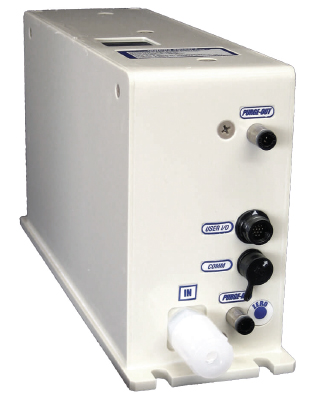
Semiconductor manufacturing applications, among many others, require all PFA-wetted surfaces for proper functionality, accuracy and chemical compatibility. The CPFM-8800 Series Coriolis Flow Meters are comprised of two assemblies: one containing the sensor and the other supporting electronics. The combination provides highly accurate measurements ±1 percent) of mass flow rate, total mass, and temperature.
The CPFM-8800 Flow Meter family features a measurement range of 50 to 4,000 gallons per minute, a fluid temperature range of 64.4 to 122 degrees Fahrenheit (18 to 50 degrees Celsius) and a maximum operating pressure of 80 psig (5.5 bar). It is ideal for highly corrosive chemicals, ultra-high-purity chemicals, water, slurries or solutions with solids or entrapped gases, and fluids with varying density or viscosity.
The Coriolis principle does not only apply to flow meters. Malema also manufactures Coriolis mass flow controllers in the CMFC-5000 Series and CMFC-6000 Series, a line of closed-loop flow controllers designed for high-purity fluids, such as deionized (DI) water, harsh chemicals and CMP polishing slurries used in the semiconductor industry.
CMFC-5000 and CMFC-6000 Coriolis Flow Controllers pair a Coriolis flow meter with a high-purity control valve. In operation, the user inputs a set point through an analog signal. The flow control module’s electronics continuously compare this set-point value with the flow rate reported by the flow meter and provide a constant feedback signal to modulate the control valve to maintain the desired set point. The control algorithm with the flow meter and valve achieves fast, accurate and repeatable control.
The CMFC-5000 features a flow range from 50 gallons per minute to as high as 5,000 gallons per minute, while the CMFC-6000 has a flow range of 20 to 4,000 gallons per minute. Both flow controllers control the flow rate within ±1.5 percent of the set point, making them ideal for fluid-blending and fluid-dispensing applications. The controllers also feature a two-second response time with the ability to drop to under a second for most applications, two types of control valves and PTFE/PFA-wetted-part construction.
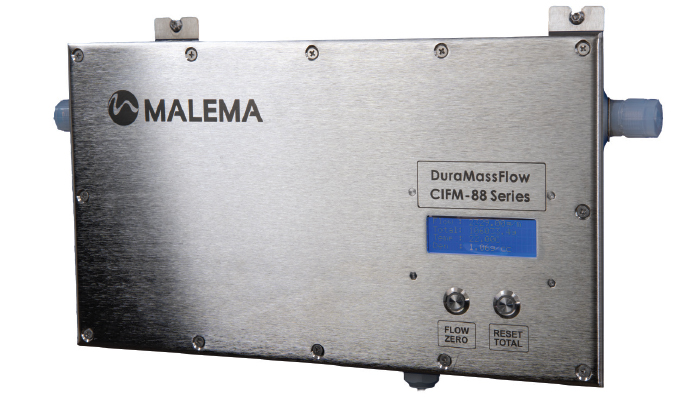
Malema has recently introduced a Coriolis flow meter specifically designed for industrial applications. The CIFM- 88 Series DuraMassFlow PFA Coriolis Mass Flow Meter was engineered with a patented design and built with corrosion-resistant PFA wetted material, the ideal solution for measuring aggressive acids and alkalis in chemical and industrial processes. Housed in a durable stainless-steel enclosure, the CIFM-88 is designed to withstand harsh industrial environments and meet IP65 and CE standards. A built-in four-line LCD panel provides real-time data on flow rate, totalized flow, temperature and density.
CONCLUSION
Flow meters are essential technology for measuring the flow of fluids, gases and vapors, superseding traditional versions of this technology in applications with varying viscosities and characteristics.
The Coriolis flow meter features a versatile principle allowing it to measure a wide range of fluids with high accuracy without performance setbacks. Its fluid measurement performance is independent of a fluid’s properties, eliminating the need for calibration when switching to different fluids.
Accuracy is also unaffected by flow variations, meaning the flow meter will still provide the same accuracy measurements under laminar or turbulent flow conditions. Even entrapped gases (up to 30 percent) are unable to impact the performance of a Coriolis flow meter. The versatility and superior accuracy of this technology deliver unparalleled performance in an abundance of challenging applications across growing industries.
Jay Rajagopalan is the senior director of engineering and product management for Malema, Boca Raton, Florida, and can be reached at jay.rajagopalan@psgdover.com. Malema is a product brand of PSG, a Dover company. PSG is the global pump, metering and dispensing-solution expert, enabling the safe and efficient transfer of critical and valuable fluids that require optimal performance and reliability in applications where it matters most. Additionally, PSG is a leading provider of flow meters designed to reduce waste and downtime while accurately measuring, monitoring and controlling the distribution of fluids. Headquartered in Downers Grove, Illinois, PSG is comprised of several world-class brands, including Abaque, All-Flo, Almatec, Blackmer, CPC Biotech, Ebsray, em-tec, Griswold, Hydro, ipp, Malema, Mouvex, Neptune, Quantex, and Wilden. PSG products are manufactured on three continents—North America, Europe, and Asia—in state-of-the-art facilities that practice lean manufacturing and are ISO-certified. PSG is part of the Pumps & Process Solutions segment of Dover Corporation. For more information, please visit www.psgdover.com.