

The study and quantification of oil and gas reservoirs is of critical importance for petroleum engineering and energy extraction. Of particular importance is characterizing the petrophysical properties of the hydrocarbon laden source rocks. Techniques are used to measure the porosity and capillary pressure of the geological samples—these include mercury intrusion capillary pressure (MICP), scanning electron microscopy (SEM), and nuclear magnetic resonance (NMR). These techniques are used in concert to characterize the pore structure of the hydrocarbon reservoirs. In order to justify the capital expense and risk of a hydrocarbon extraction operation, extensive testing must be performed to determine economic viability and to assure high rates of hydrocarbon extraction.
The high compression strength of Master Bond EP30QF makes it a good candidate for epoxy sealing of core samples undergoing high pressure MICP testing. Research highlighted in this case study examines MICP testing of normal and parallel composites composed of high and low permeability sandstone rocks.
Modelling fluid dynamics of geological reservoirs is complex due to the heterogeneities found due to rock stratification. When moving between layers or within fissures, fluid movements will differ greatly than when transported within a relatively homogenous rock layer. Different rock strata possess different permeabilities and pore structures. A material such as Master Bond EP30QF then provides researchers with a useful tool for conducting their high pressure, petrogeological testing.
KEY PARAMETERS AND REQUIREMENTS
Mercury Intrusion Capillary Pressure (MICP) testing requires mercury to be introduced to the rock samples at high pressures. The measured capillary pressure is the difference in pressure between two immiscible fluids that form an interface within a porous material. Mercury invades the pores, displacing air, when the injection pressure is higher than the capillary threshold pressure—this provides quantification of the capillary pressure and the pore radius. Sealing the rock samples is critical to assure that the intended flow path is measured. Commercially available polymer shrink sleeves can be used to seal core samples prior to testing—however, these materials have limited pressure capabilities with one commercially available material failing at pressures above 10,000 psi.
To enable high pressure testing and the ability to characterize smaller pore sizes, high compressive strength epoxies can be used to seal the samples allowing for higher test pressures. Researchers utilized Master Bond EP30QF successfully in their experiments up to a pressure of 40,000 psi. Master Bond EP30QF is a quartz-filled, relatively fast setting, two-part epoxy, which provides a high degree of dimensional stability. The low viscosity and excellent flow properties of EP30QF make it suitable for potting and encapsulation processes. The product provides a high-performance bond to both inorganic materials and plastics.
TESTING PROCEDURES
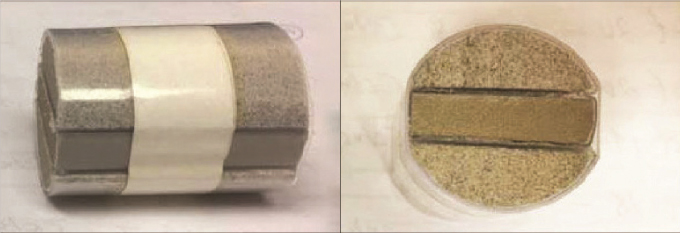
Research conducted at the University of Texas utilized a combination of Master Bond EP30QF epoxy and a commercially available shrink sleeve. The high resulting bond strength and compressive strength of Master Bond EP3OQF makes it a suitable epoxy-based sealant for this high-pressure application, while the addition of the shrink sleeve may provide additional reinforcing effects further enabling high pressure testing. Figure 1 illustrates a parallel composite test specimen comprised of high and low permeability sandstones encapsulated with epoxy and the shrink sleeve material.
The experimental work sought to characterize the capillary pressure and flow characteristics of two different clastic sandstone materials with flow normal and parallel to the interfacial layers. Berea sandstone is a high permeability clastic rock with exceptionally high uniformity and exhibiting permeability values of 150-350 mD.
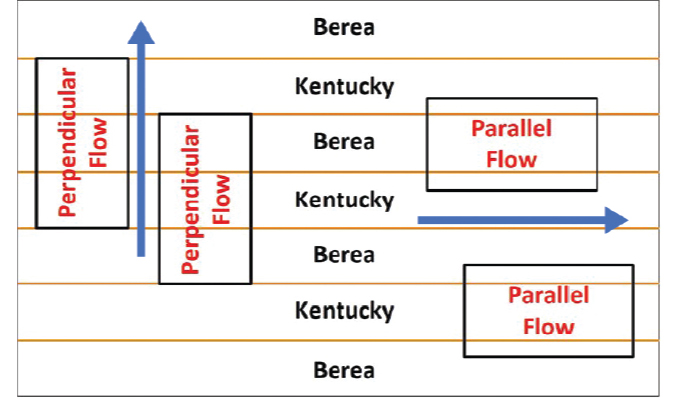
Kentucky sandstone is a low permeability sandstone with smaller grain size resulting in significantly lower permeability value of 0.1-1 mD. Composites and neat materials impregnated with brine were studied via NMR to determine porosity and pore-size distribution while MICP was used to determine the capillary pressures of the neat materials as well as the normal and parallel composite orientations. Figure 2 summarizes the sample configurations used: Berea:Kentucky:Berea and Kentucky:Berea:Kentucky composites arranged to measure perpendicular (normal) flow as well as parallel flow through the samples.
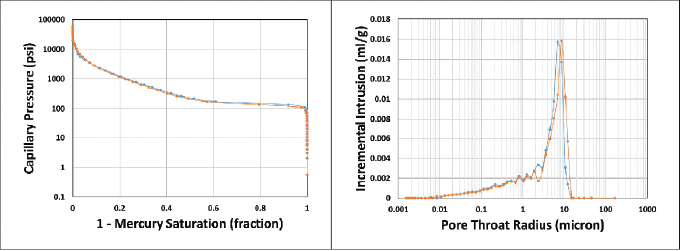
An excerpt of the MICP test data is shown in figure 3 for the neat Berea sandstone sample. In addition to the air-mercury two-fluid system, n-decane-brine capillary pressures were also measured—n-decane and brine simulates the conditions found during hydraulic fracturing. In hydraulic fracturing, a wetting aqueous liquid is injected at high pressure to fracture and displace hydrocarbons from within the pores of the reservoir.
RESULTS
The outcome of the experiments conducted at Texas yielded successful data. The Master Bond EP30QF in concert with the shrink sleeves enabled high pressure measurements. The author states that tests were conducted up to 60,000 psi. Absolute and relative permeabilities as well as porosities and pore-size distribution were determined for the sample materials and composites. High compressive strength epoxies such as Master Bond EP30QF then provide a useful tool in the study of petrophysical properties of geological samples.
Dr. Walter Brenner is technical director of Master Bond. Dr. Brenner received his Ph.D. in polymer chemistry from Brooklyn Polytechnical Institute. He is a renowned professor of chemical engineering and has served as a consultant for various U.S. government agencies. He holds numerous patents and is credited with being the first person to develop electron beam radiation curing. Master Bond Inc. was founded in 1975. Our focus has been on developing the best in epoxies, silicones, polyurethanes, polysulfides, UV cures, and other specialty adhesive systems. We are true specialists in our field and are recognized by many as the preeminent adhesive formulation company in the world. Through research and development, we have been able to create innovative, new compounds with truly unique properties. For more information, visit www.masterbond.com.