


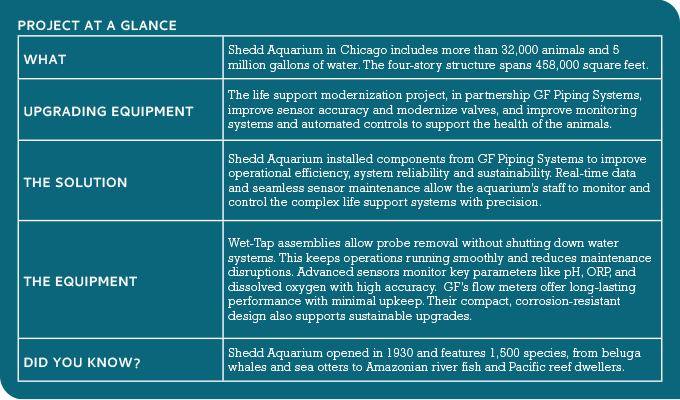
Nearly two million people walk through Chicago’s Shedd Aquarium each year, drawn to the coral forests, stingray pools, shark habitats and freshwater worlds that fill its galleries. What they never see is the infrastructure that makes these environments possible. Behind the exhibits, inside mechanical rooms and through raceways of PVC and thermoplastic valves runs one of the most sophisticated life support systems in North America.
Across the facility, more than five million gallons of water move continuously through filtration loops, flow meters and UV units, deaeration towers and automated systems. The system supports nearly 32,000 animals and a wide range of unique habitats. It is engineered with a requirement that confronts few industrial operations: it can never stop.
A WORLD IN CONSTANT MOTION
In industrial water treatment, shutdowns happen. In an aquarium with living animals, they can’t. Sensor calibration, valve maintenance, pH control, salinity adjustment, and all treatment tasks must be performed without interrupting flow. A lapse of even a few minutes could destabilize a sensitive habitat or stress the animals within it.
To meet these operational demands, Shedd’s life support design has evolved significantly over the past decade. Modernization efforts accelerated as the aquarium expanded conservation programs and rebuilt habitats to meet higher standards for water chemistry, environmental enrichment and animal welfare.
The result is a hybrid system where mechanical reliability, automated analytics, and adaptive control work in tandem. When new exhibits are constructed, the infrastructure around them is engineered to maintain strict tolerances from the moment water enters the habitat through the first introduction of animals.
“At the start of these new habitats, we have uncured concrete,” says Shedd Systems Operations Manager Nick Kaiser. “And occasionally, we may have to acid etch them, so we can use these devices to monitor the pH, but also they relay output of the Signet 9900 Transmitter to control pH adjustments and remove any kind of contaminants that may be in that concrete before we have the exhibit ready for the animal.”
This level of precision requires instrumentation that can operate continuously, even during maintenance.
INSTRUMENTATION WITHOUT INTERRUPTION
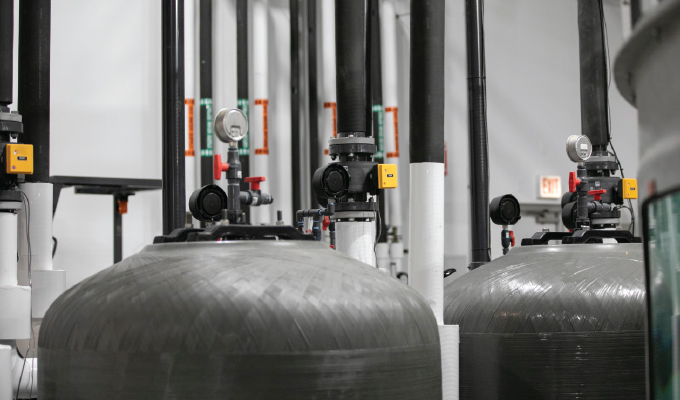
To support uninterrupted operation, Shedd upgraded its monitoring and control architecture with technologies supplied by GF Piping Systems. These include advanced automation components, corrosion-resistant valves and flow measurement devices designed for high accuracy in complex piping geometries.
One of the most critical upgrades involves Shedd’s sensor maintenance workflow. Traditional pH or ORP probes require a shutdown or bypass to remove them for calibration, cleaning, and occasional replacement. GF’s, Wet-Tap assemblies, supplied and installed as part of the modernization, solved that.
“The awesome thing about these Wet-Tap assemblies is I can come up here and remove that probe without getting wet, without having to isolate the system,” explains Kaiser. “We can maintain live water flow without having to shut anything down.”
Flow measurement posed other challenges. With tight mechanical rooms and dense pipe routing, traditional insertion-style flow sensors would have required much longer straight runs of pipe to be installed, at significant additional cost, or resulted in lower accuracy. GF’s full-bore FlowtraMag meters offered a solution designed for tight spaces.
“It can be difficult for an insertion-style flow sensor,” notes Director of GF Piping Systems Brian LaBelle. “With the full-bore mag, you get high degrees of accuracy even in tight geometries like this.”
The result is a monitoring network that maintains performance without demanding structural changes or downtime.
EVERY DROP COUNTS
For the operations team, life support isn’t only about filtration and flow. Managing water for living systems requires precise control of a continuously changing product.
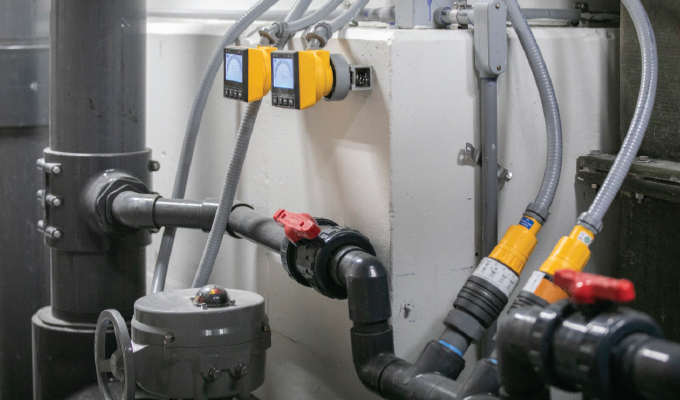
Thermoplastic valves were supplied to replace corroding metal components, offering longer life and smoother operation in saltwater environments. Continuous ORP measurement keeps disinfection systems stable. UV units are calibrated to precise flow rates to maintain pathogen control without over- or under-treating.
“We’re talking about manual valves, actuated valves, flow, level, pressure, temperature, pH, ORP, dissolved oxygen, electrical conductivity for salinity,” says LaBelle.
Each parameter is monitored not just for engineering performance, but for its biological impact. The Signet 3719 pH/ORP Wet‑Tap assemblies support electrode removal and reinstallation under full process pressure.
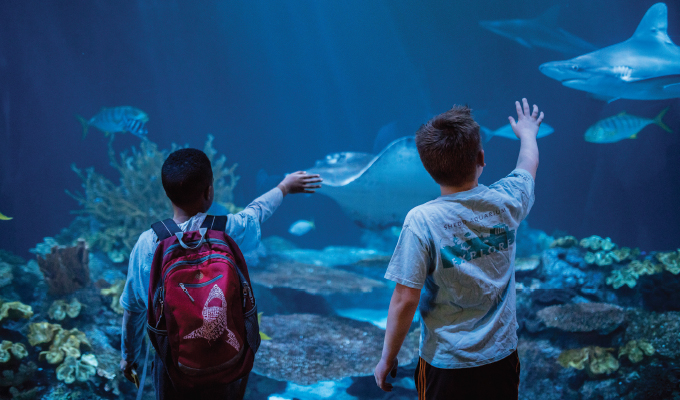
For an institution with a conservation mandate, including a long history of wildlife rescue, habitat rehabilitation and sustainable operations, these engineering investments have broader implications. Efficient water management contributes directly to reduced resource use, lower environmental impact and the long-term wellbeing of the animals in Shedd’s care.
ADAPTING FOR CARE AND CONSERVATION
One of Shedd’s long-term goals is designing systems that are as adaptable as the science behind animal care. As habitats evolve, so must the infrastructure behind them.
That philosophy influences equipment selection, redundancy planning and system layout. Thermoplastic valve upgrades, next-generation sensors and modular control systems allow Shedd to modernize piece by piece without disrupting ongoing operations.
For GF Piping Systems, the decades-long partnership has been defined by this continuous evolution. “Shedd Aquarium has been a great customer of GF Industry and Infrastructure Flow Solutions,” LaBelle adds. “It’s been our pleasure and honor to support them over the decades, and we look forward to decades more.”
BEHIND CLEAR WATER
The public sees shimmering habitats. The operations team sees a complex ecosystem of pumps, valves, sensors and controls working in perfect coordination. Shedd Aquarium’s life support system is the unseen engine that safeguards thousands of animals every hour of every day. Because at Shedd Aquarium, every clear tank tells only part of the story. The real work happens where few will ever see, and GF Piping Systems is the supplier behind the scenes, providing components that keep these systems running.
Sabrina Boccuzzi covers topics related to building, construction, industry trends and broader trade topics. She can be reached at sboccuzzi@mercurymc.us. As the leading flow solutions provider for the safe and sustainable transport of fluids, GF Piping Systems creates connections for life. The division focuses on industry-leading leak-free piping solutions for numerous demanding end-market segments. Its strong focus on customer-centricity and innovation is reflected by its global sales, service, and manufacturing footprint and its award-winning portfolio, including fittings, valves, pipes, automation, fabrication, and jointing technologies. For more information, visit www.gfps.com.