


Miss part 1? Read it here.
The first part of this series explored international and industry standards—namely ANSI, API, ASME, and ISO—and now we turn our attention to safety and compliance certifications, including CE, ATEX, IECEx, and QPS. The broader goal of each of these certifications is to provide both manufacturers and end users with confidence in the safety, reliability, efficiency of their equipment. However, as you’ll see below, the distinctions between these different certifications can be important depending on your regions, application focus, or design.
Certifications such as CE, ATEX, IECEx, or QPS are often used by end-users as a sign of quality, easily communicating that equipment has been designed and tested to minimize potential risks to their critical applications or the environment. For manufacturers, they present instant credibility whenever an OEM brings a new product to market or expands existing products into a new region.
SAFETY AND COMPLIANCE CERTIFICATIONS
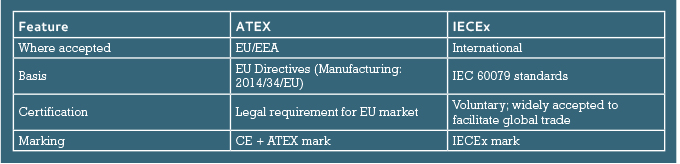
Safety and compliance certifications —including CE, ATEX, IECEx, and QPS—ensure pumps meet strict regulatory and operational requirements in different regions and industries. These certifications verify that equipment is designed and tested to protect users, facilities, and the environment from potential risks. They also provide global credibility, helping manufacturers access broader markets with trusted, proven solutions.
CE Marking (Conformité Européenne)
Translated from the French for “European conformity,” Conformité Européenne (CE) is a certification mark that indicates a product complies with the European Union (EU) safety, health, and environmental protection requirements. It’s required for many products sold within the European Economic Area (EEA).
To receive the CE marking, a manufacturer outside the EU must do three things:
- Ensure the product complies with all applicable EU directives/regulations.
- Prepare a Declaration of Conformity.
- Affix the CE mark on the product.
Depending on the product, compliance can be shown by self-certification for low-risk products. For higher-risk products, a Notified Body third-party assessment is needed. Every Notified Body is approved by a specific EU member state and is given a designated four-digit number. While the NB pertains to one particular state, their assessment services are valid across the entire EU/EEA market.
The CE Declaration of Conformity is the manufacturer’s signed guarantee that their product is safe, compliant, and legally fit to be sold within the EEA. This formal, written statement provided by the manufacturer typically includes:
- Product identification (model/type, serial numbers)
- Manufacturer’s name and address
- List of relevant EU directives/regulations applied
- Sentence expressly detailing that the product fulfills all the relevant provisions of the directive
- If relevant, reference to harmonized EN standards (European Norms; technical standards that gives manufacturers a “presumption of conformity”)
- Place and date of issue
- Identity and signature of the person authorized to draw up the declaration on behalf of the manufacturer, or his authorized representative
Once a manufacturer has completed these two steps, they are granted the CE mark. This mark not only signifies that the product has been approved for sale in the EU, but serves as a sign of product safety and compliance to countries outside Europe.
ATEX (Atmosphères Explosibles)
From the French for ATmosphères EXplosibles, ATEX certification is required in the EU and EEA for all products, equipment, and protective systems used in explosive atmospheres where there’s a risk of explosion from flammable gases, vapors, mists, or combustible dusts. It ensures that the product is designed and tested to prevent ignition sources that could trigger explosions.
The ATEX 2014/34/EU certification applies to manufacturers specifically and requires a CE marking as well as an ATEX marking. Products requiring this certification include:
- Electrical equipment (motors, sensors, lighting, switches).
- Non-electrical equipment that can create sparks or heat (gearboxes, brakes, pumps).
- Protective systems (explosion suppression systems, flame arrestors).
To receive an ATEX certification, manufacturers must go through a four-step process. First, they must determine the equipment group and category. This depends on the type of explosive atmosphere and risk level. There are two groups: mining (group I), and non-mining (group II). There are also three categories, with category one providing the highest protection.
Second is the conformity assessment. Like the CE mark, low-risk equipment can be self-declared, while higher-risk equipment needs NB involvement. Third is technical documentation, which includes risk analysis, design files, and test results.
Fourth is the mark itself. If approved, this includes the CE mark, ATEX symbol, group and category, and NB number (if applicable).
IECEx (International Electrotechnical Commission Explosive Atmospheres)
Often thought of as the global equivalent of ATEX, IECEx is a voluntary international certification system that verifies equipment, services, and personnel working in explosive atmospheres meet strict safety standards in industries such oil and gas, mining, chemical processing, and grain handling, where there’s risk of explosion from gases, vapors, or dusts.
IECEx certification is accepted in many countries outside the EU. Some of the largest include Australia, New Zealand, Canada, South Africa, parts of Asia, and the Middle East. Having the IECEx certification helps avoid duplicate testing and approvals when exporting to participating countries.
There are three key aspects to being granted an IECEx certificate. These include:
- Standards. IECEx certifications are based on the IEC 60079 series of standards that apply to electrical and non-electrical equipment for explosive atmospheres
- Scope of certification. Equipment certification verifies equipment is explosion-protected; service facility certification covers repair/service workshops, and personnel Competence Certification ensures workers are trained/qualified.
- Marking. Similar to ATEX, equipment that has been IECEx certified is marked with the IECEx symbol as well as protection.
QPS Evaluation Services
QPS Certification is a product testing, inspection, and certification service provided by QPS Evaluation Services Inc., an accredited, independent third-party testing and certification body. QPS certification indicates that electrical, electronic, and related products meet North American and international safety standards.
Headquartered in Toronto, Canada, QPS is an IECEx certification body and test lab and is accredited by organizations such as SCC (Standards Council of Canada) and OSHA/NRTL. Products bearing the QPS certification mark (sometimes with “C” and/or “US” indicators to show approval for Canada, the U.S., or both) have been tested and approved by QPS for product safety and compliance.
QPS certification covers a number of products, including:
- Electrical and electronic equipment
- Hazardous location/explosion-proof equipment
- Industrial machinery
- Medical devices
- Energy systems (batteries, renewable tech, EV charging stations, etc.)
Recognized globally for product approvals, QPS offers Field Evaluation Labels (for one-off or custom equipment) as well as Listing and Certification Marks in North America. Internationally, QPS offers IECEx certification for explosive atmospheres, as well as IECEE CB scheme for global acceptance of electrical products.
CONCLUSION
In today’s competitive and safety-focused manufacturing landscape, adherence to standards and accreditations is more than a regulatory requirement—it is a mark of quality, reliability, and trust. From process-focused standards like ANSI, API, ASME, and ISO to safety and global compliance certifications such as CE, ATEX, IECEx, and QPS, these benchmarks ensure pumps perform efficiently, safely, and consistently across industries and regions.
For manufacturers, compliance streamlines production and opens doors to international markets, while for end users, it provides confidence that the equipment meets rigorous performance and safety expectations. Ultimately, understanding and implementing these standards is essential for building pumps that stand up to the demands of modern industrial applications and deliver long-term value.
Casey Bowes is the owner/CEO of Finish Thompson, Inc. in Erie, Pennsylvania. Finish Thompson Inc. designs and manufactures pumps for the safe transfer of a wide variety of corrosive fluids. Products include sealless mag-drive centrifugal pumps with run-dry capability, mechanically sealed pumps, drum/barrel pumps, vertical mag-drive pumps, multi-stage pumps and the FTI Air line of air operated double diaphragm (AODD) pumps. For more information, visit www.finishthompson.com.